
 EN
EN
 English
 Français
 Español

Solar Wall Light

Understanding the core differences between monocrystalline and polycrystalline solar panel technologies is essential for anyone involved in the design, sourcing, or application of solar outdoor wall lights. Conversion efficiency sits at the heart of this comparison — and the distinctions go far deeper than raw percentage points.
Monocrystalline solar panels are manufactured from a single continuous silicon crystal, grown through the Czochralski process. The silicon atoms are arranged in a highly uniform lattice, which allows electrons to travel through the material with minimal resistance or disruption. This structural regularity is the primary reason monocrystalline cells achieve superior photon-to-electron conversion rates.
Polycrystalline solar panels, by contrast, are produced by melting multiple silicon fragments together and casting them into blocks. The resulting material contains numerous individual crystal grains separated by grain boundaries — structural interfaces where electrons are more likely to recombine before contributing to electrical current. These grain boundaries act as energy loss points, fundamentally limiting the panel's conversion potential.
This difference in crystal structure is not a manufacturing shortcut but a deliberate trade-off between production cost and output performance. Understanding it is key to making informed decisions when specifying panels for solar outdoor wall lights or any solar-powered application.
In mass production, monocrystalline solar panels achieve conversion efficiencies ranging from 19% to 23% under Standard Test Conditions (STC: 1000 W/m² irradiance, 25°C cell temperature, AM 1.5 spectrum). High-performance variants utilizing PERC (Passivated Emitter and Rear Cell), TOPCon (Tunnel Oxide Passivated Contact), or HJT (Heterojunction Technology) architectures can exceed 24%, with laboratory records pushing past 26%.
Polycrystalline solar panels typically deliver efficiencies between 15% and 18% in commercial production. Surface texturing, anti-reflective coatings, and back-surface field optimization have helped push some polycrystalline products toward 19%, but surpassing 20% remains a significant technical challenge at scale.
In practical terms, two panels of identical surface area tested side by side under STC conditions will show the monocrystalline unit generating approximately 15–20% more power output. For solar outdoor wall lights — where panel dimensions are tightly constrained by product form factor — this efficiency gap directly translates into longer illumination time, higher lumen output, or the ability to sustain performance through multiple consecutive low-irradiance days.
Standard efficiency ratings are measured under ideal laboratory conditions, but outdoor solar products must perform across a far wider range of real-world scenarios. Dawn, dusk, overcast skies, and seasonal low-sun angles are not edge cases — they represent a substantial portion of a solar panel's annual operating hours.
Under low irradiance conditions below 200 W/m², monocrystalline panels demonstrate a clear advantage in low-light response characteristics. The underlying reasons are rooted in semiconductor physics: monocrystalline cells exhibit lower dark current and more stable open-circuit voltage (Voc) at reduced light levels. As irradiance drops, the performance degradation curve for monocrystalline panels is shallower than for polycrystalline equivalents.
For solar outdoor wall lights installed in high-latitude regions, urban environments with frequent overcast conditions, or locations subject to partial shading from buildings and vegetation, this difference in low-light behavior has direct operational consequences. Monocrystalline panels continue charging batteries at useful current levels well into conditions where polycrystalline panels have effectively ceased meaningful energy harvest. This resilience is a primary technical argument for specifying monocrystalline cells in premium solar lighting products.
Solar panel efficiency is temperature-dependent. As cell temperature rises above the 25°C STC baseline, output power decreases — a characteristic quantified by the maximum power temperature coefficient (Pmax temperature coefficient).
Monocrystalline solar panels typically carry a Pmax temperature coefficient of -0.35%/°C to -0.40%/°C. Polycrystalline panels generally register -0.40%/°C to -0.45%/°C. While these figures appear similar in isolation, their practical impact becomes significant in high-temperature installation environments.
In summer conditions where panel surface temperatures reach 65°C — common for wall-mounted units in direct sun exposure — a temperature rise of 40°C above STC baseline produces the following power losses:
For solar outdoor wall lights with compact panel areas of 1–3W rated capacity, a 2–4% incremental power loss under peak thermal load represents a meaningful reduction in daily energy harvest. Over a full summer season, this accumulates into a measurable difference in battery state-of-charge and nighttime illumination reliability.
Light-induced degradation (LID) refers to the efficiency loss that occurs in silicon solar cells during initial exposure to sunlight, typically within the first 100–200 operating hours. The primary mechanism in standard boron-doped silicon involves the formation of boron-oxygen complexes that act as recombination centers.
Standard polycrystalline solar panels can exhibit initial LID-related efficiency losses of 1.5% to 3%, depending on boron concentration and material quality. Monocrystalline PERC cells were also susceptible to LID, but advances in gallium doping and laser-fired contact processes have reduced LID in modern monocrystalline products to below 0.5%.
Beyond initial degradation, long-term annual power output decline rates differ between technologies. Premium monocrystalline panels from established manufacturers are rated to retain 80% or more of initial power output after 25 years, with annual degradation rates of approximately 0.4–0.5%/year. Polycrystalline panels typically show annual degradation of 0.5–0.7%/year, resulting in 25-year power retention of 75–80%.
For solar outdoor wall lights positioned as durable, low-maintenance outdoor fixtures with multi-year performance warranties, long-term panel stability is a specification that directly supports product credibility and after-sales reliability.
Technical performance is not the only differentiator relevant to solar outdoor wall lights. Visual appearance carries significant weight in architectural and residential outdoor lighting markets.
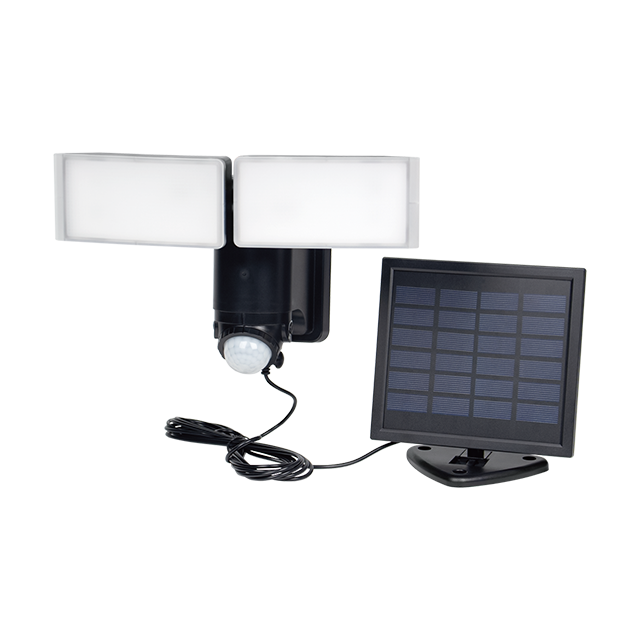
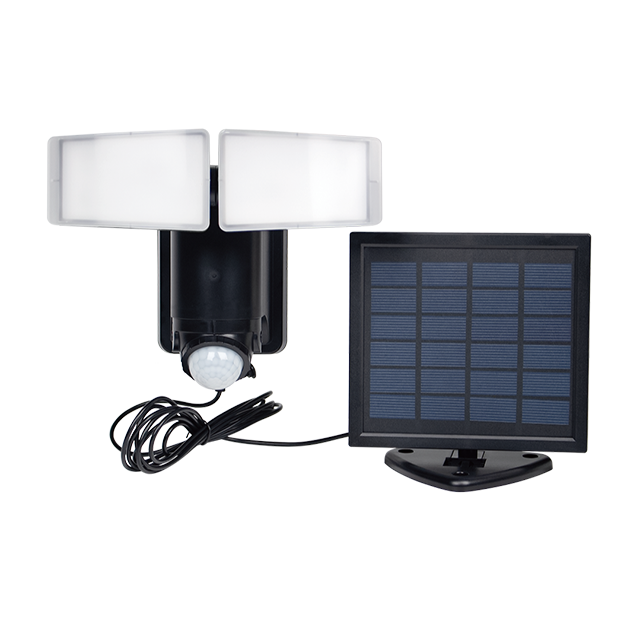
Monocrystalline cells present a uniform, deep blue or solid black surface appearance, depending on anti-reflective coating selection. This visual consistency allows seamless integration with modern building facades, minimalist exterior design schemes, and dark-body luminaire housings. Black monocrystalline cells, in particular, have become the preferred choice for premium design-oriented solar lighting products targeting European and North American markets.
Polycrystalline cells, due to their multi-grain structure, display an irregular speckled blue pattern across the panel surface. While functionally neutral, this appearance is increasingly considered visually inconsistent compared to the refined look of monocrystalline alternatives. In market segments where product aesthetics influence purchasing decisions alongside performance specifications, this has contributed to a gradual shift away from polycrystalline panels in visible-panel solar outdoor wall light designs.
Monocrystalline silicon production requires high-purity silicon feedstock and energy-intensive crystal pulling processes. Historically, this resulted in a substantial cost premium over polycrystalline manufacturing. However, the widespread adoption of diamond wire sawing technology, improvements in crystal growth yield rates, and sustained reductions in silicon raw material costs have significantly compressed the price differential between the two technologies.
As of current industry pricing, the cost premium of monocrystalline panels over polycrystalline equivalents has narrowed to a level where the efficiency advantage of monocrystalline panels often justifies the marginal additional cost — particularly in size-constrained applications such as solar outdoor wall lights, where every additional watt of peak power output from a fixed panel area carries direct product performance value.
Product development teams and ODM manufacturers typically align panel technology selection with target price segments. Entry-level solar outdoor wall lights oriented toward volume price-sensitive markets may continue to utilize polycrystalline panels. Mid-range and premium products — particularly those positioned for export to markets with high performance expectations — increasingly specify monocrystalline or monocrystalline PERC cells as a baseline requirement.
The evolution of crystalline silicon solar technology continues beyond standard monocrystalline cells. Three advanced architectures are progressively entering the solar outdoor lighting supply chain:
For solar outdoor wall lights designed for maximum performance in constrained panel geometries or challenging installation conditions, these advanced monocrystalline variants represent the current and near-future state of the art in photovoltaic conversion efficiency.
The selection between monocrystalline and polycrystalline solar panels for outdoor wall light applications involves a multi-dimensional evaluation. Monocrystalline panels offer measurable advantages across conversion efficiency, low-light performance, thermal behavior, long-term degradation stability, and visual consistency. These advantages are most pronounced in applications where panel surface area is restricted, installation environments include variable or reduced irradiance, product longevity is a key specification, and end-market positioning supports a performance-based value proposition.
Polycrystalline panels retain relevance in cost-sensitive product tiers where installation conditions are favorable (high direct irradiance, minimal shading) and panel size constraints are less critical. However, the narrowing cost gap between the two technologies — combined with growing consumer and specification-writer awareness of efficiency differences — continues to shift the solar outdoor wall lights industry toward monocrystalline as the standard baseline technology rather than a premium option.
Copyright © Ningbo Loyal Lighting Technology Co., Ltd. All Rights Reserved.
 Wholesale Solar Garden Lights Manufacturers